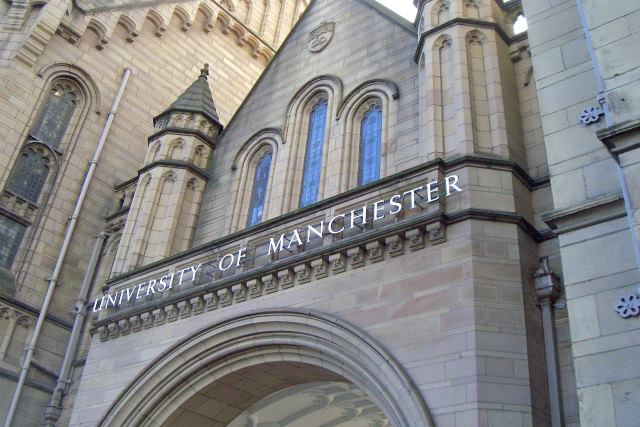
The University of Manchester, in its current form, was created by the merger of the Victoria University of Manchester and The University of Manchester Institute of Science and Technology (UMIST) in 2004. It is the largest single-site university in the UK and is home to more than 40,000 students from almost every country in the world. The University of Manchester ranks 15th in the UK and 27th in the QS World University Rankings 2020. It is a member of the prestigious Russell Group. Research Excellence Framework 2014 (REF) rated 83% of the university's research as internationally excellent and world-leading. The research areas the university focuses on are cancer, global inequality, energy and industrial biotechnology. Its music department ranks 2nd in the country, and the university is in the top 10 for anthropology, dentistry, pharmacy, physics and astronomy, sociology and linguistics. Computer Science and Marketing were among the most popular majors among Bulgarian students in the 2017-2018 academic year. Nine out of ten graduates find a job almost immediately or go on to master's and doctoral studies. The university is proud of its 25 Nobel laureates.
Manchester is one of the cities where the Industrial Revolution was felt most strongly. In the 19th century the city grew dramatically thanks to its thriving cotton industry, which earned it the nickname “Cottonpolis”. The New York Times included it in its 2015 list of the best places in the world to visit. With its beautiful Victorian buildings, numerous theaters, galleries and more than 400 pubs, clubs and restaurants, Manchester is a vibrant, culturally diverse metropolis where you can have fun even on a student budget. It is also home to 2 of the big Premier League teams – Manchester United and Manchester City.
Main programs and majors (For a detailed list, ask one of our consultants)
- Accounting and Finance
- Aerospace Engineering
- Anatomical Science
- Arabic Studies
- Archaeology
- Architecture
- Art History and Visual Studies
- Audiology
- Biochemistry
- Biology
- Biomedical Sciences
- Biotechnology
- Business and Management
- Cell Biology
- Chemical Engineering and Analytical Science
- Chemistry
- Classics and Ancient History
- Cognitive Neuroscience and Psychology
- Computer Science
- Criminology
- Dentistry
- Development Studies
- Drama
- Earth, Atmospheric and Environmental Sciences
- East Asian Studies
- Economics
- Education
- Electrical and Electronic Engineering
- English Literature, American Studies and Creative Writing
- Environmental Sciences
- European Languages and Cultures
- Fashion
- French Studies
- Genetics
- Geography
- Geology
- German Studies
- Government, Politics and International Relations
- History
- Human Resources
- Humanitarianism and Conflict Response
- Informatics
- International Development
- Italian Studies
- Law
- Leadership & Management (Education)
- Leisure
- Life Sciences
- Linguistics and English Language
- Materials
- Mathematics
- Mechanical Engineering
- Medical Biochemistry
- Medicine
- Microbiology
- Middle Eastern Studies
- Modern Languages and Cultures
- Molecular Biology
- Neuroscience
- Nursing, Midwifery and Social Work
- Optometry
- Petroleum Engineering
- Pharmacology
- Pharmacy and Environmental Management
- Plant Science
- Politics
- Psychology
- Religions and Theology
- Russian and East European Studies
- Screen Studies
- Social Anthropology
- Social Sciences
- Social Statistics
- Sociology
- Spanish, Portuguese and Latin American Studies
- Speech and Language Therapy
- Sustainable Consumption
- Textiles and Paper Science
- Zoology
Key information
Program length:
3-5 years for bachelor's programs
1-2 years for master's programs
Academic year:
2 semesters - September and January
Start of the year:
September and January (for some master's programs only)
Application deadline:
October 15 for medicine and dentistry
January 15 is the recommended deadline for most majors. The final cutoff is June 30, but those applications will not be given priority.
There is no deadline for master's and PhD/doctoral programs, but the university advises applying as early as possible.
Admission requirements:
High school diploma with a minimum GPA of 5.0, which varies depending on the major. Master's admission requires a bachelor's degree with a minimum grade of 4.
IELTS
For bachelor's and master's programs, between 6.0 and 7.5, depending on the major.
TOEFL
For bachelor's and master's programs, between 73 and 105, depending on the major.
Cambridge English: Advanced/Proficiency
For bachelor's and master's programs, between 169 and 191, depending on the major.
Scholarships and loans
The tuition fee for bachelor's programs is £9000. The UK government provides student loans with favorable repayment terms. Students begin repaying the loan only once they earn an annual salary of more than £21000. For more information, ask one of our consultants.
Master's programs range from £5300 to £18000. Taking out a loan for them is harder, but not impossible.
Accommodation:
University residence halls cost between £3437 and £6906 per year, depending on the residence and room type. Private accommodation outside the university residence halls costs £4134–£6864.