
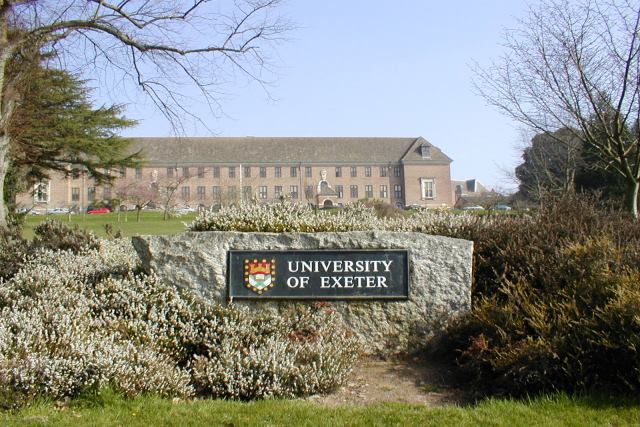
The University of Exeter was founded as early as 1855, but received its Royal Charter only 100 years later. It is a member of the prestigious Russell Group. The Research Excellence Framework 2014 ranked the university 16th, with 82% of its research rated world-leading or internationally excellent. It is a leader in research on climate change and weather systems, as well as in technology, the humanities and the social sciences. One of the university's important recent discoveries concerns the identification and treatment of new forms of diabetes. The University of Exeter is one of the best universities in the country, ranked 10th, while the QS World University Rankings 2015/2016 place it 161st. It is the best university in the country for sports science and is in the top 10 for finance and accounting, anthropology, archaeology, biological sciences, business management, ancient history, economics, engineering, geology, geography and environmental science, history of art, medical technology, philosophy, politics, physics, psychology and more. Many programs offer the opportunity to study or work abroad, or to do a placement in the UK.
The city where the university is located - Exeter - is non-metropolitan and has more than 2,000 years of history. It combines a diverse culture with a dynamic student environment. The city has many cultural venues, such as theaters, galleries, museums and live music performances. Some of its more prominent landmarks are Exeter Cathedral, built in the 12th century, the city's medieval underground passages, the clock tower, the Guildhall, the architectural ensemble and the iron bridge. The nearby countryside allows students to get away from the city and immerse themselves in a variety of outdoor activities, such as cycling or kayaking. The city's nightclubs offer all kinds of music styles to suit every taste. Overall, Exeter's diverse social scene makes it an extremely attractive place to spend your student years.
Main programs and majors (For a detailed list, ask one of our advisors)
- Accounting and Finance
- Anthropology
- Arab and Islamic Studies
- Archaeology
- Art History and Visual Culture
- Biosciences
- Business and Management
- Classics and Ancient History
- Clean Energy
- Computer Science and IT
- Drama
- Economics
- Engineering
- English
- Environmental Science
- Film Studies
- Flexible Combined Honours
- Geography
- Geology
- History
- Human Sciences
- Law
- Liberal Arts
- Mathematics
- Medical Imaging
- Medical Sciences
- Medicine
- Mining Engineering
- Modern Languages
- Natural Sciences
- Philosophy
- Physics and Astronomy
- Politics and International Relations
- Psychology
- Sociology
- Sport and Health Sciences
- Theology and Religion
Key information
Duration of study:
3-5 years for Bachelor's programs
1-2 years for Master's programs
Academic year:
2 semesters - September and January
Start of the year:
September and January (for some programs only)
Application deadline:
October 15 for medicine
January 15 is the recommended deadline for most majors. The final cutoff is June 30, but those applications will not be given priority.
March 24 for art and design.
There is no deadline for Master's and PhD/doctoral programs, but the university advises applying by July 24, 2015.
Admission requirements:
High school diploma with a minimum GPA of 5.0, depending on the major. For Master's and doctoral programs, a Bachelor's or Master's degree, respectively, with a grade of at least 4.0, equivalent to the British Lower Second 2:2, depending on the major.
IELTS
For Bachelor's programs, between 6.5-7.5, depending on the major. For Master's programs, between 6.0-7.5
TOEFL
For Bachelor's and Master's programs, between 90-110, depending on the major.
Cambridge English: Advanced/Proficiency
For Bachelor's programs, a minimum of C, and for Master's programs, a minimum of 176, depending on the major.
Scholarships and loans
The tuition fee for Bachelor's programs is £9,000. The UK government provides student loans with favorable repayment terms. Students only start repaying the loan once they earn an annual salary of more than £21,000. For more information, ask one of our advisors.
The Medical Imaging program is funded by the NHS, as is the final year for Medicine students. If you spend a year on an Erasmus exchange, you pay only 15% of the full annual fee. The UK government provides tuition fee loans with favorable repayment terms. Master's programs cost between £6,700 and £11,500, the MBA £22,500, and doctoral programs £4,100. Getting a loan for them is more difficult, but not impossible.
Accommodation:
University residence halls cost between £3,180 and £5,750 per year, depending on the hall and room type. Accommodation in a house or apartment outside the university residence halls costs between £3,600 and £7,000 per year.