
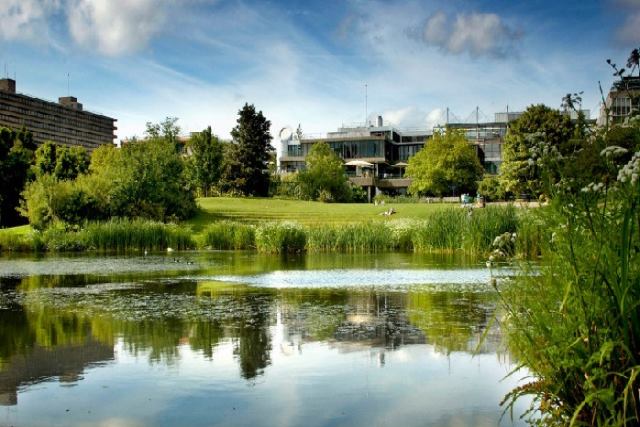
The University of Bath celebrates its 50th anniversary in 2016. Despite its short history, the university has established itself as one of the top higher education institutions, not only in the country but in the world. It is ranked 11th in the UK and 159th in the QS World University Rankings 2015/2016, but 12th in the QS Top 50 Universities Under 50. The Research Excellence Framework 2014 placed it 12th in the UK for research quality, with 87% of its research rated "internationally excellent" or "world-leading". The University of Bath aims for its research to have an impact beyond academia, and to that end it works with various professionals from industry and with policymakers. This means teaching at the university is based on the most innovative ideas and the latest know-how. The university is the best in the country for architecture, and 20 more of the 28 subjects taught at the university are in the top 10 - finance and accounting, manufacturing engineering, biological sciences, chemical engineering, chemistry, civil engineering, economics, French, Iberian languages, marketing, mathematics, mechanical engineering, pharmacy, physics and astronomy, politics, psychology, social work, sociology and sports science. The university has one of the best-developed placement programs, maintaining links with numerous businesses, employers and volunteer organizations both in the UK and abroad. These include companies such as Airbus, the World Bank, Nike and Microsoft. Most programs offer the option of a one-year placement or an Erasmus exchange, and 60% of students take advantage of this opportunity. University of Bath graduates are in the top 10 for earnings - 85% of all employed graduates hold jobs in the top 3 occupational groups.
The university is located in the beautiful city of Bath in South West England. The city was built as a spa town by the Romans, under the Latin name Aquae Sulis, around 60 years after the beginning of the Common Era. It has a temple as well as the famous Roman Baths, which have been restored and survive today. Its popularity as a spa town in the Georgian era led to considerable expansion of the city and left a legacy of beautiful Georgian architecture. In 1987, UNESCO declared the city a World Heritage Site to protect and preserve its beautiful culture and rich history.
Main programs and majors (For a detailed list, ask one of our advisors)
- Accounting and Finance
- Aerospace Engineering
- Architecture
- Biology, Biochemistry and Molecular & Cellular Biology
- Biomedical Sciences
- Business Administration
- Chemical and Biochemical Engineering
- Chemistry
- Chemistry for Drug Discovery
- Civil Engineering and Civil & Architectural Engineering
- Computer Science
- Computer Systems Engineering
- Economics
- Education in an International Context
- Education with Psychology
- Electrical & Electronic Engineering
- Electrical Power Engineering
- Electronic & Communication Engineering
- Electronic Engineering with Space Science & Technology
- International Management
- Language and Politics
- Management
- Mathematical Sciences
- Mathematics & Physics
- Mechanical Engineering
- Modern Languages and European Studies
- Natural Sciences
- Pharmacology
- Pharmacy
- Physical Activity and Health
- Physics
- Politics and International Relations
- Psychology
- Social Policy
- Social Sciences
- Social Work and Applied Social Studies
- Sociology
- Sport and Exercise Science
- Sports Performance
Key information
Duration of study:
3-4 years for Bachelor's programs
1-2 years for Master's programs
Academic year:
2 semesters - September and January
Start of the year:
September and January (for some majors)
Admission deadline:
January 15 is the recommended deadline for most majors. The final cutoff is June 30, but those applications will not be given priority.
March 24 for art and design.
There is no deadline for Master's and PhD/doctoral programs, but the university advises applying as early as possible.
Admission requirements:
High school diploma, depending on the major. Requirements for Master's admission depend on the major.
IELTS
For Bachelor's and Master's programs, between 6.0-7.0, depending on the major
Cambridge English: Advanced/Proficiency
For Bachelor's and Master's programs, between 175-193, depending on the major
Scholarships and loans
The tuition fee for Bachelor's programs is £9,000. The UK government provides student loans with favorable repayment terms. Students only start repaying the loan once they earn an annual salary of more than £21,000. For more information, ask one of our advisors.
Master's programs range from £6,000 to £10,000; MBA - £28,000; doctoral programs - £4,400. Getting a loan for them is more difficult, but not impossible.
Accommodation:
University residence halls cost between £95 and £130 per week, depending on the hall and room type. Accommodation outside the university residence halls costs £3,700-£4,200.