
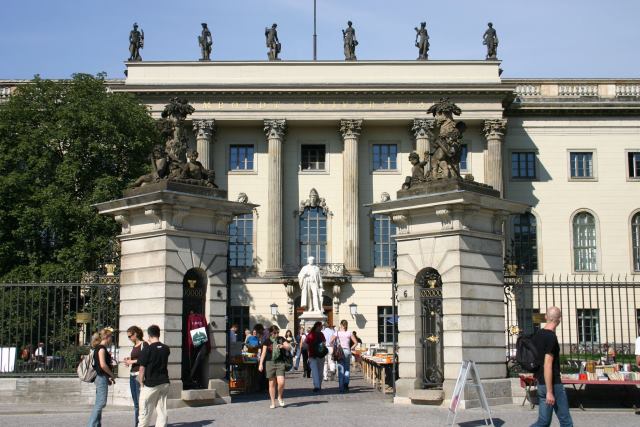
Humboldt-Universität zu Berlin was founded in 1810 by the famous Prussian politician and philosopher Wilhelm von Humboldt, who gave rise to the Humboldtian model of higher education, namely education based on inquiry and research. This is the model that all higher education institutions still follow today. Humboldt-Universität zu Berlin ranks 6th in Germany and 134th in the QS World University Rankings. The university was one of the first to introduce bachelor's and master's degrees. It maintains academic partnerships with more than 400 universities around the world for Erasmus programs. As a typical follower of the Humboldtian model, Humboldt-Universität zu Berlin strives to make an impact through its research at both the local and the global level. The university's areas of expertise are ancient studies and the history of science; philosophy; economics; sciences focusing on theoretical biology; neuroscience and immunobiology; mathematics as a key technology; materials and optical sciences; and climate and regeneration. Humboldt-Universität zu Berlin has a worldwide reputation, and a degree from it opens many doors.
Located in the northeastern part of the country, Berlin is the capital of Germany and the second largest city in Europe after London. Historically, it was the capital of the Kingdom of Prussia (1701–1918), the German Empire (1871–1918), the Weimar Republic (1919–1933) and the Third Reich (1933–1945). At the end of World War II the city was divided into two parts: East Berlin, which was declared the capital of the German Democratic Republic, and West Berlin, which became part of the Federal Republic of Germany, whose capital was Bonn. Berlin is a world city of cultural, political, media and scientific importance and is among the most popular tourist destinations in the European Union. The city is home to many prestigious universities, research centers, cultural monuments, museums and sports facilities.
Main programs and majors
- Agricultural Sciences
- Ancient Greek Studies
- Archaeology and Cultural Studies
- Biology
- Biophysics
- Business Administration
- Chemistry
- Computer Science
- Deaf Studies
- Economics
- Education Studies
- English Studies
- European Ehnology
- Fine Art and Image History
- French Studies
- Geography
- German Linguistics
- German Literature Studies
- Historical Linguistics
- History
- Horticultural Sciences
- Information Managament and Information Technology
- Italian Studies
- Latin Studies
- Mathematics
- Musicology
- Philosophy
- Physics
- Protestant Theology
- Psychology
- Regional Studies Asia
- Rehabilitation Pedagogy
- Russian Studies
- Scandinavian Studies
- Social Sciences
- Spanish Studies
- Sport Sciences
The following majors conclude with a state examination – dentistry, medicine, law and pharmacy.
Key information
Program length:
3-5 years for bachelor's programs
1-6 years for master's and doctoral programs
Academic year:
2 semesters – Winter and Summer
Start of the year:
October and April (for some programs only)
Application deadline:
July 15 for the Winter intake
January 15 for the Summer intake
For master's programs with restricted admission, May 31. For master's programs with unrestricted admission, July 15, and for applicants with high school diplomas equivalent to the German Abitur – August 31.
Admission requirements
High school diploma.
All bachelor's programs are taught in German and therefore require proof of proficiency, but there are master's programs taught entirely in English.
Language requirements
DSH certificate at a minimum of level 2 (Deutsche Sprachprüfung für den Hochschulzugang, German Language Examination for University Admission)
The Große Deutsche Sprachdiplom (GDS) at level C2
Test Deutsch als Fremdsprache (TestDaF) with a minimum of 4 in all sections
Deutsches Sprachdiplom (DSD) at level 2 with a minimum of C1 in each section.
Scholarships and loans
In Germany, education is considered a public good to which everyone is entitled, which is why most programs and universities are tuition-free, with minor exceptions. There is, however, a semester fee of €297.87. It includes a public transport pass for the entire semester. This applies to both bachelor's and master's programs.
Accommodation:
Accommodation in Berlin costs between €390 and €430.